Algorithms for Embedded Systems
We are a software development company specializing in Model-Based Design (MBD) methods for embedded systems.
We also handle the end-to-end development of control algorithms, from concept through design and simulation to implementation on hardware platforms.

We support our customers by ...
Design and implementation of control algorithms
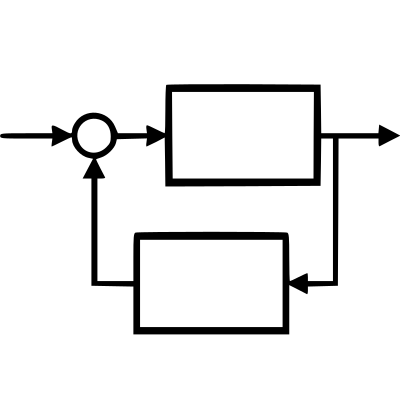
Do you need to develop a control or signal processing algorithm for a new product? Or perhaps your code is already developed but requires thorough verification in a simulation environment? Utilizing tools such as Matlab/Simulink, we can design and test solutions in a virtual environment using the Model-Based Design (MBD) method.
This approach allows rapid prototyping and verification of assumptions at an early stage of the project, resulting in increased efficiency and quality of final products.
Transfer of existing solutions from simulation environment to embedded platforms
You have a solution that is ready and verified in a simulation environment, such as Matlab/Simulink, and is prepared for implementation. However, it is not clear how to convert this solution into executable code for the final product. Leveraging our extensive experience in production code generation for embedded processors and programmable logic controllers, we can significantly speed-up and simplify this step.
The automatic generation of embedded code fundamentally transforms the team's workflow. Rather than manually writing thousands of lines of code, the team can now automatically generate it, leading to increased productivity, enhanced quality, and a boost in innovation..
Dynamic modeling of systems and devices
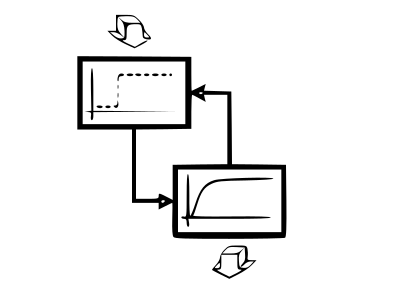
Is your product challenging to test thoroughly in the lab, or is it expected to operate in a complex or hazardous environment where failure is not an option? By employing mathematical modeling methods, we can replicate the environment in which the designed algorithm will operate or even model the entire device as a digital twin, thereby minimizing the risk of design errors.
With mathematical simulations, it is possible to verify assumptions in a time-efficient and cost-effective manner. Additionally, with system simulations, it becomes possible to manage larger and more complex projects, as simulations connect all components in each design iteration, making it easier for teams to handle interactions and dependencies.
Implementing the Model-Based Design method
We support our customers in the implementation of the MBD method for software development, especially for control and signal processing algorithms. Model-based design is extremely important in complex applications such as engine control systems, autopilots or ABS systems. However, it can be used just as effectively and economically in less complex projects. This approach combines all the points mentioned in the preceding sections. When properly implemented, it allows a number of additional benefits, such as:
• Capture knowledge in the form of models, which are also a form of executable specification, much more readable than the traditional one,
• System simulation that allows for the analysis of various potential scenarios of product use,
• Virtual prototyping, allowing software development separately from the final platform,
• Improved testing and verification,
• Significantly improved automation.
Organizations that use the Model-Based Design method achieve up to 60% savings compared to traditional methods.

Organizations that use the Model-Based Design method achieve savings of 20 to 60% compared to traditional methods.
Most of these savings come from better requirements analysis combined with early and continuous testing. Because requirements and design assumptions are simulated using mathematical models, defects are detected much earlier in the development process, when they are still simple and an order of magnitude less costly to fix.

Model-Based Design, can speed up the product development cycle by up to 50%.
The acceleration is mainly due to:
• Capability to develop software in isolation from the target platform,
• Elimination of manual steps and reduction of human error through the automation of key processes such as report creation, coding, and verification.
• Automatic code generation for multiple hardware platforms simultaneously.

We have the experience to support up to as many platforms simultaneously, generating code for them automatically. We hope to break this record together.
We have experience in automatic code generation for various embedded processors and PLCs. The benefit of the MBD method is particularly noticeable when a single code base is used to generate applications for several hardware platforms simultaneously.
The tools we use 
The following technology stack consists of tools and technologies that we use to create, analyze and simulate system models before their physical realization, as well as tools for transforming mathematical or logical representation into executable code.
MathWorks

Modelica
Modelica Association

Functional Mock-up Interface
Modelica Association
Simulink PLC Coder™ generates hardware-independent code in IEC 61131-3 compliant ST (Structured Text) and LD (Ladder Diagram) languages from Simulink® models, Stateflow® diagrams and MATLAB® functions.
IEC 61131-3
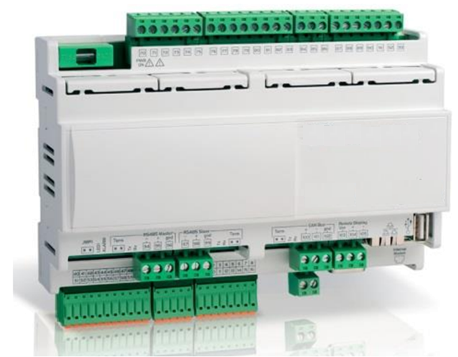
Embedded Coder® generates C/C++ code from Simulink® models, Stateflow® diagrams, and MATLAB® scripts providing readability and efficiency comparable to professionally hand-written code.
C\C++


Working with our company, you get a partner who carries out even the most complex projects with full commitment and the highest precision. We encourage you to learn more about our services and see how together we can increase the efficiency and innovation of your company.